How Our Forge Works
Built, not consumed.
Here's exactly that means.>>>
The Unit of Work
Everything is a Build
A
Forge program isn't a set of lessons. It's a sequence of Builds - typically six to ten, each producing
one section of your playbook.
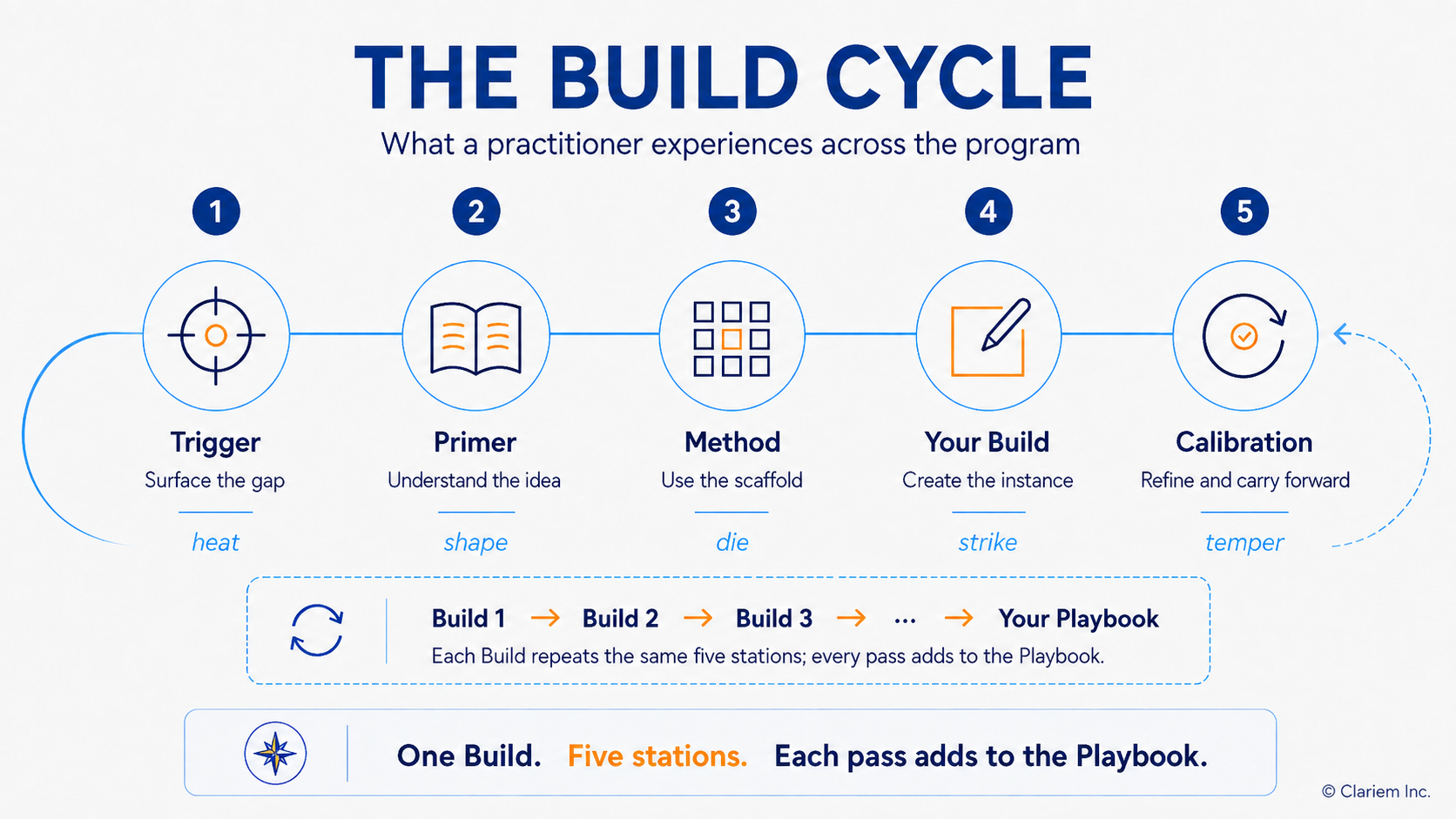
Station 1: Trigger. Three to five questions, tuned to your role and situation. You answer before you read anything. This is deliberate: we want your current thinking on the record so you can see what changes.
Station 2: Primer. Our answer to those questions. Concise, usually few pages of relevant reading. What works, why, and the conditions under which it stops working. It's also the smallest part of your time.
Station 3: Method. The actual instrument: a template, a scoring model, a sequence, a checklist. You download it, you own it, you adapt it. We call ours the scaffold; what you build from it is your instance.
Station 4: Your Build. You produce your section. You submit it. Nothing unlocks until you do. This is roughly half your time in the program and one hundred percent of the point.
Station 5: Calibration. The rubric, two or three anonymized examples at different quality levels, and guidance specific to your situation. At designated checkpoints, a written review of your actual submission.
Station 2: Primer. Our answer to those questions. Concise, usually few pages of relevant reading. What works, why, and the conditions under which it stops working. It's also the smallest part of your time.
Station 3: Method. The actual instrument: a template, a scoring model, a sequence, a checklist. You download it, you own it, you adapt it. We call ours the scaffold; what you build from it is your instance.
Station 4: Your Build. You produce your section. You submit it. Nothing unlocks until you do. This is roughly half your time in the program and one hundred percent of the point.
Station 5: Calibration. The rubric, two or three anonymized examples at different quality levels, and guidance specific to your situation. At designated checkpoints, a written review of your actual submission.
What "reviewed" means
Checkpoints, not grading
Every program has a small number of checkpoints where your submission gets read and responded to in writing - not scored, not auto-graded. You get: what your answer reveals, the harder question underneath it, and what to change before you build the next section.
Checkpoints are where most of the value sits, and they're deliberately limited. We would rather do three well than eight superficially.
Personalization
The program adapts to your situation
Before you start, you complete a short qualification. It establishes four things: your role, the situation you're in, how far along your organization already is, and your domain.
Those four answers change what you see - which trigger questions you get, which examples are shown, which guidance appears at calibration. A PMO director standing up a new function and a capability lead defending an existing one work through the same method and see different material.
As you submit reflections through the program, the picture sharpens and later sections adjust again.
Those four answers change what you see - which trigger questions you get, which examples are shown, which guidance appears at calibration. A PMO director standing up a new function and a capability lead defending an existing one work through the same method and see different material.
As you submit reflections through the program, the picture sharpens and later sections adjust again.
Copyright © 2026